•
5 min read
How to Choose an Equipment Leasing Company in Canada
A practical guide to comparing Canadian equipment leasing companies by asset fit, credit flexibility, speed, convenience, and approval path.
The best equipment leasing company is the one that can understand your asset, your cash flow, your credit profile, and your approval path quickly. For Canadian businesses, equipment leasing is often the practical choice when a bank approval is too slow, too restrictive, or not available for the situation.
Admiralty Leasing helps personal and commercial applicants finance equipment, vehicles, trailers, business assets, sale lease backs, refinancing, and residual funding. The goal is simple: help applicants get the equipment they need with a convenient process, a quick decision, and a payment structure that fits the full picture.
When should a business lease equipment?
A business should consider leasing equipment when the asset helps generate revenue, reduce downtime, expand capacity, or replace unreliable tools without using a large amount of cash upfront.
Equipment leasing can make sense for contractors, transportation companies, farms, restaurants, trades, medical practices, startups, and established businesses. Common leased assets include work trucks, trailers, heavy equipment, shop tools, commercial kitchen equipment, office technology, and specialized machinery. Asset eligibility and approval requirements vary by equipment type, applicant profile, and province.
Leasing can also help preserve working capital. Monthly payments may leave more cash available for payroll, inventory, repairs, marketing, and operating expenses. Some businesses may also receive tax advantages from leasing, depending on how the lease is structured. Applicants should confirm tax treatment with their accountant. For more detail, read Why Lease?.
Equipment leasing vs buying: what is the difference?
Equipment leasing spreads the cost of an asset over time, while buying usually requires more cash or bank credit upfront.
- Choose leasing if you want predictable payments, capital preservation, flexible approval options, or a way to match payments to the useful life of the equipment.
- Choose buying if you have excess cash, want immediate ownership, and do not need to preserve capital for other business needs.
- Choose refinancing or sale lease back if you already own equipment and want to unlock capital from an existing asset.
For many Canadian businesses, the right decision is not simply lease versus buy. The better question is whether the equipment will help the business earn enough, save enough, or operate better enough to justify the payment.
Bank financing vs flexible equipment leasing
For a worked cost example and questions to discuss with your broker, read lease vs. buy equipment in Canada.
Bank financing is usually the best fit for applicants with strong credit, established financials, and enough time to wait through a longer review. Those applicants may qualify for lower rates because the bank is focused on lower-risk files.
Flexible equipment leasing is often more useful when the applicant needs a faster answer, has credit challenges, needs a creative structure, or does not fit a standard bank approval box. The rate may be higher than traditional bank financing, but the tradeoff can be speed, convenience, and access to funding when the equipment is needed.
For many businesses, waiting several weeks for a bank decision can delay work, revenue, or delivery. Admiralty Leasing aims to make a decision on a completed application within one business day, which can help applicants move forward while the asset or opportunity is still available.
Direct funder vs leasing broker: why does it matter?
A direct funder can review the application, communicate the decision, and structure the transaction without passing the file through multiple outside parties.
That matters when timing and clarity are important. Direct funding allows faster decisions, more consistent communication, and more flexibility when reviewing an applicant's credit, finances, asset, down payment, collateral, and requested term.
Admiralty Leasing is a direct Canadian lease funder, not just a referral point. Learn more on the About Admiralty page.
What should you look for in an equipment leasing company?
Look for a leasing company that explains its approval process, supports your asset type, understands your credit profile, and communicates directly.
- Asset fit: The company should understand the equipment, vehicle, trailer, or business asset you want to finance.
- Credit flexibility: The company should look beyond a single credit score when the file has other strengths.
- Fast decisions: A quick response can matter when the seller, asset, or business opportunity cannot wait.
- Practical structure: The lease payment should fit how the equipment will be used.
- Canadian experience: A company with long-term Canadian leasing experience can better understand regional industries and applicant situations.
Can you lease equipment with credit challenges?
Credit challenges do not automatically prevent equipment leasing. Credit matters, but it is only one part of the application review. The Credit Levels page explains how different profiles may be reviewed.
Admiralty Leasing works with a broad range of credit profiles, including applicants who may not qualify through a traditional bank. The review may consider the asset, down payment, collateral, time in business, income, application details, requested term length, and the overall strength of the file.
This full-picture review can help applicants with slow pays, limited history, high credit utilization, or other credit issues. Admiralty may consider applicants with a past, discharged bankruptcy, depending on its age, the explanation, current income, payment history, and the overall application. A challenged credit profile may affect the structure, but it does not always end the conversation.
What should you prepare before applying?
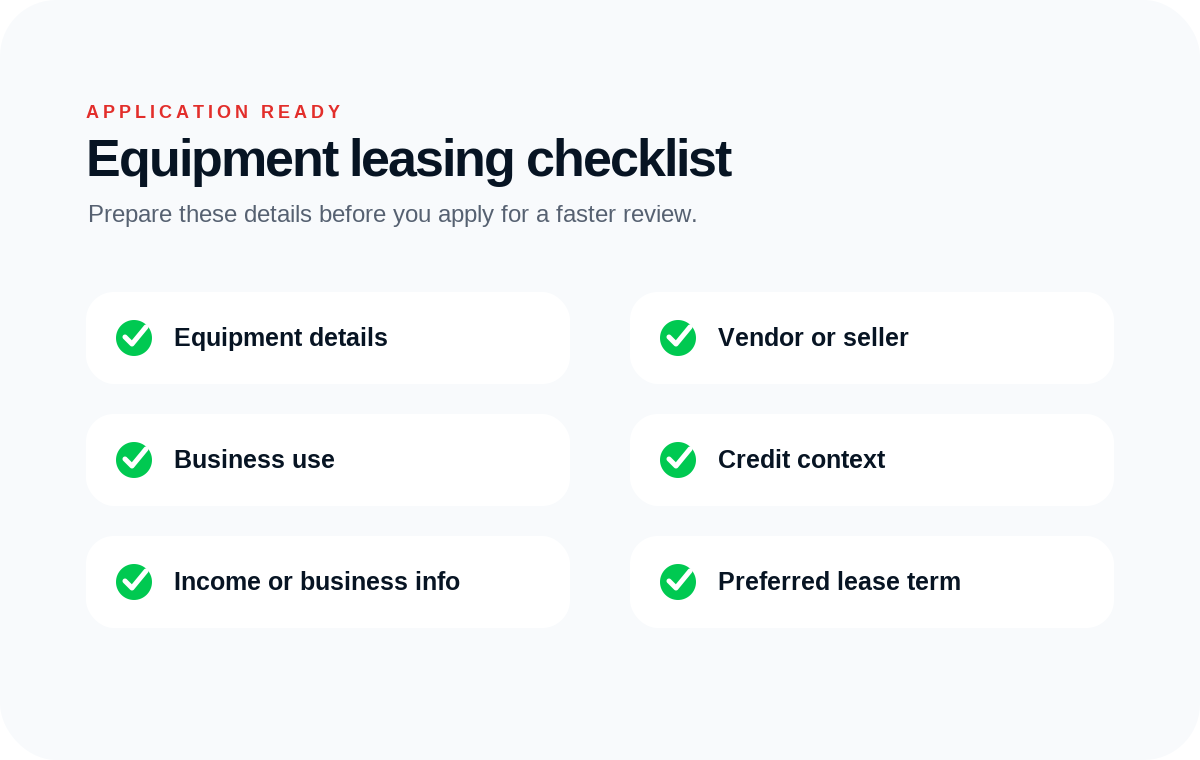
A complete application helps the leasing team understand the request faster and identify an approvable path.
- Equipment quote or invoice
- Seller and asset details
- Requested lease amount and term
- Proposed down payment
- Personal or business identification
- Income or banking information when requested
- A clear explanation of previous credit problems
- Co-lessee or collateral information where applicable
Clear information helps the leasing company connect the asset to its business purpose. That makes the file easier to review and easier to structure.
Start with the asset, then build the lease around it
The strongest equipment leasing applications start with a clear asset and a clear business use. If the equipment helps the applicant produce revenue, complete jobs, reduce downtime, or improve operations, the lease request is easier to understand.
Admiralty Leasing reviews personal and commercial lease applications for equipment, vehicles, trailers, and business assets in British Columbia, Alberta, Yukon, Saskatchewan, Manitoba, Ontario, Nova Scotia, New Brunswick, and Prince Edward Island. If you are comparing options, start by identifying the asset, the seller, the price, and how it will help you operate.
You can begin with an Admiralty Leasing application or contact the team with questions about equipment leasing in Canada.